



Jubilee
A Black Grotesque About the Living and the Dead
George Tabori (born György Tábori; 24 May 1914, Budapest – 23 July 2007, Berlin) wrote Jubilee on commission for the German theatre Schauspielhaus Bochum. He staged the play himself on 30 December 1983, exactly fifty years to the day after Hitler came to power. He also appeared in the production as the ghost of Arnold’s father. For this text, he received one of Germany’s most prestigious theatre awards, the Mülheim Dramatists’ Prize (Mülheimer Dramatikerpreis).
Tabori experienced Hitler’s rise to power firsthand. Between 1932 and 1934, he worked at the Adlon & Hessler Hotel in Berlin. So when, after graduating from school, he wanted to devote himself to literary work, he chose instead to follow his father’s advice: “My dear son, since there are more poets than readers in our country, and many of them end up committing suicide by lying down on railway tracks, I have no choice but to send you into the hotel business.” In his book Autodafé, Tabori returns to this period of his life in Berlin, and those memories are also reflected in the lines of Jubilee, especially in the characters Arnold and his wife Lotte. The contrast between the fading peaceful years between the wars and the rise of the brown terror of Nazism therefore feels highly authentic.
Lotte: The Führer was standing by the window, waving. And you, idiot, waved back at him.
Arnold: He looked so lonely.
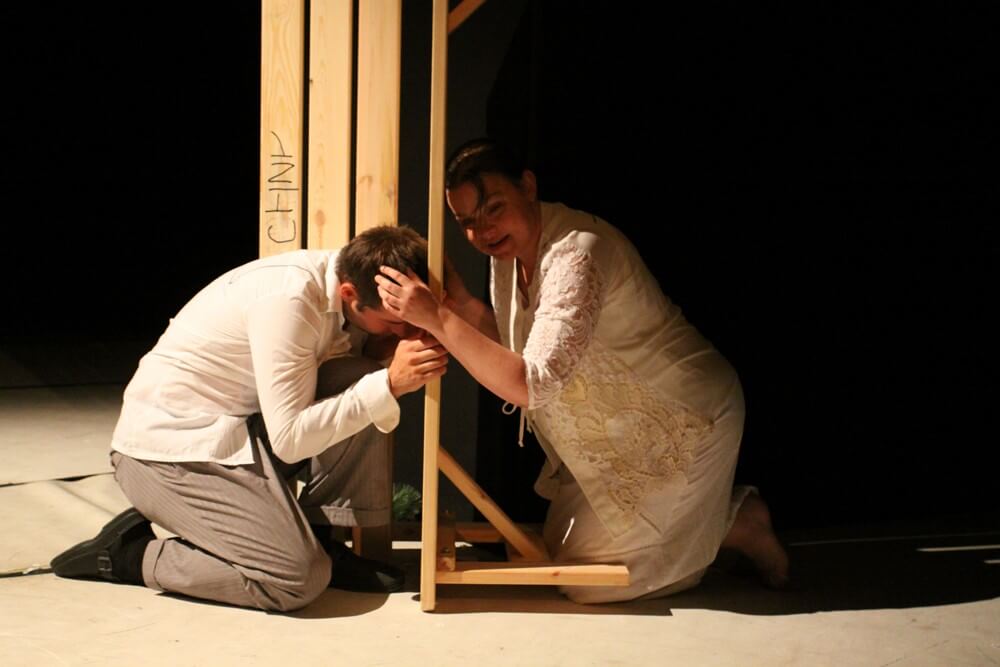
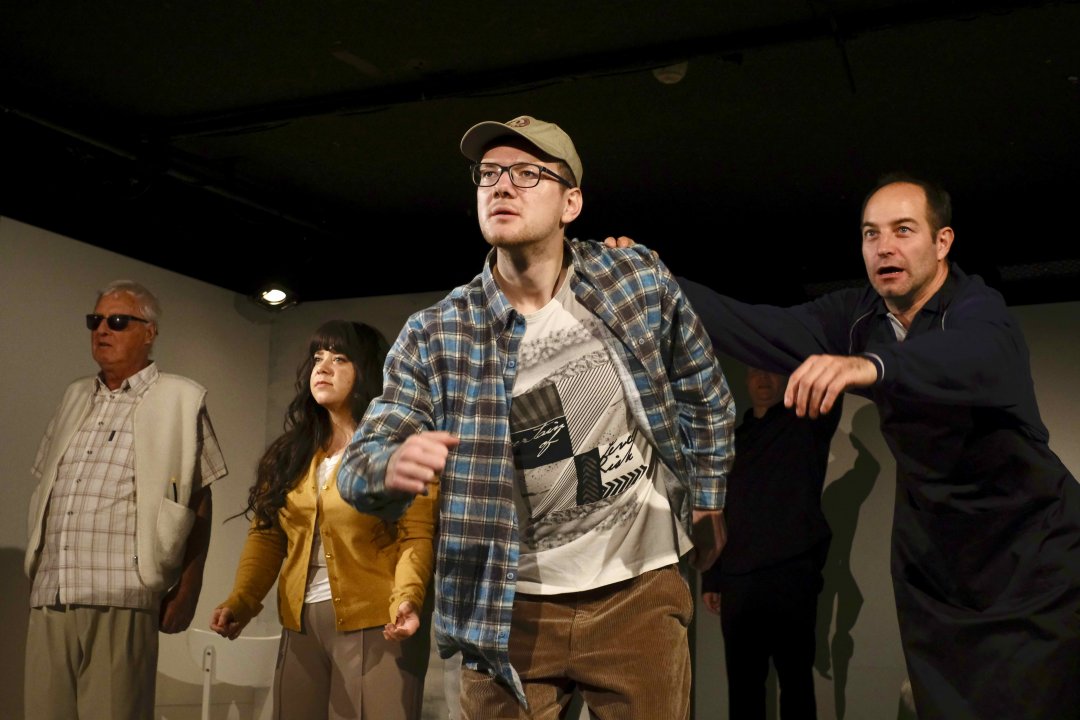
Tabori’s Jubilee is presented by Divadlo Zrakáč in a production directed by Kristína Chlepková. Coincidentally, these days also mark the round centenary of the author’s birth.
It is a brilliantly written play in which the horrors of the Holocaust come alive, confronting present-day reality in a tragicomic form. Sadly, the play remains relevant today. Tabori wrote a black grotesque about the living and the dead, about criminals and their victims, about life in the death camps, but also about the hope that such horrors will never be repeated. It is a powerful appeal to both the audience and society, because even today we can see that the atmosphere of intolerance and fascist salutes in the streets is far from belonging only to history books.
Brief Biography of the Author
GEORGE TABORI (24 May 1914, Budapest – 23 July 2007, Berlin)
A novelist, playwright, and director of Hungarian origin. In 1936, he emigrated to Britain, where he worked as a journalist and wrote his first novels. Between 1947 and 1971, he worked in the United States as a screenwriter. Under the influence of Bertolt Brecht, whose plays he also translated, he began writing and directing for the theatre. In 1971, he returned to Europe, where he undertook major directing projects, particularly in Bremen, Munich, and Vienna, including cycles of classical plays and productions of works by Samuel Beckett, William Shakespeare, and others. In 1987, he founded the experimental theatre group Kreis in Vienna, which he led until 1990. Among his best-known works are Mein Kampf and White Man and Red Face. Through his reflections on Jewish fate and the problem of Nazism, Tabori addressed some of the most urgent issues facing modern humanity, especially the capacity for mutual understanding and the preservation of the fundamental values of human dignity.
Direction, Set Design, and Music Selection:
Kristína Chlepková
Cast:
Arnold, a musician: Andrej Svetko
Lotte, his wife: Silvia Milošovičová
Mitzi, their niece: Lucia Medveď-Pataková
Otto, a hairdresser: Marek Hlina / Peter Zbranek
Helmut, Otto’s wife: Stanislav Sokol
Jürgen, Helmut’s nephew: Peter Gombárik
Ghost of Arnold’s Father: Ľuboš Korenčík / Marek Hlina
Gravediggers: Eva Barániková, Peter Janotka
Assistant:
Milada Svetková
Premiere:
11 and 12 June 2014 at 7:00 p.m.
Štúdio 12, Jakubovo námestie 12, Bratislava
Poster – premiere of the play Jubilee
The production was also made possible thanks to a grant from the Ministry of Culture of the Slovak Republic for the preparation and staging of a theatre production by visually impaired actors within Divadlo Zrakáč.